Chinese Tattoo Guide · Reviewed against a native Chinese editor's notes
Traditional vs simplified Chinese for tattoos
Why there are two writing systems
Traditional characters are the older forms, used continuously for centuries. In the 1950s, mainland China introduced a simplified set to make literacy faster to acquire: common characters were reduced to fewer strokes or replaced with simpler shapes. Taiwan, Hong Kong and Macau kept the traditional forms. Today both systems are standard and both are used daily, which is why the same word can look completely different depending on where you are.
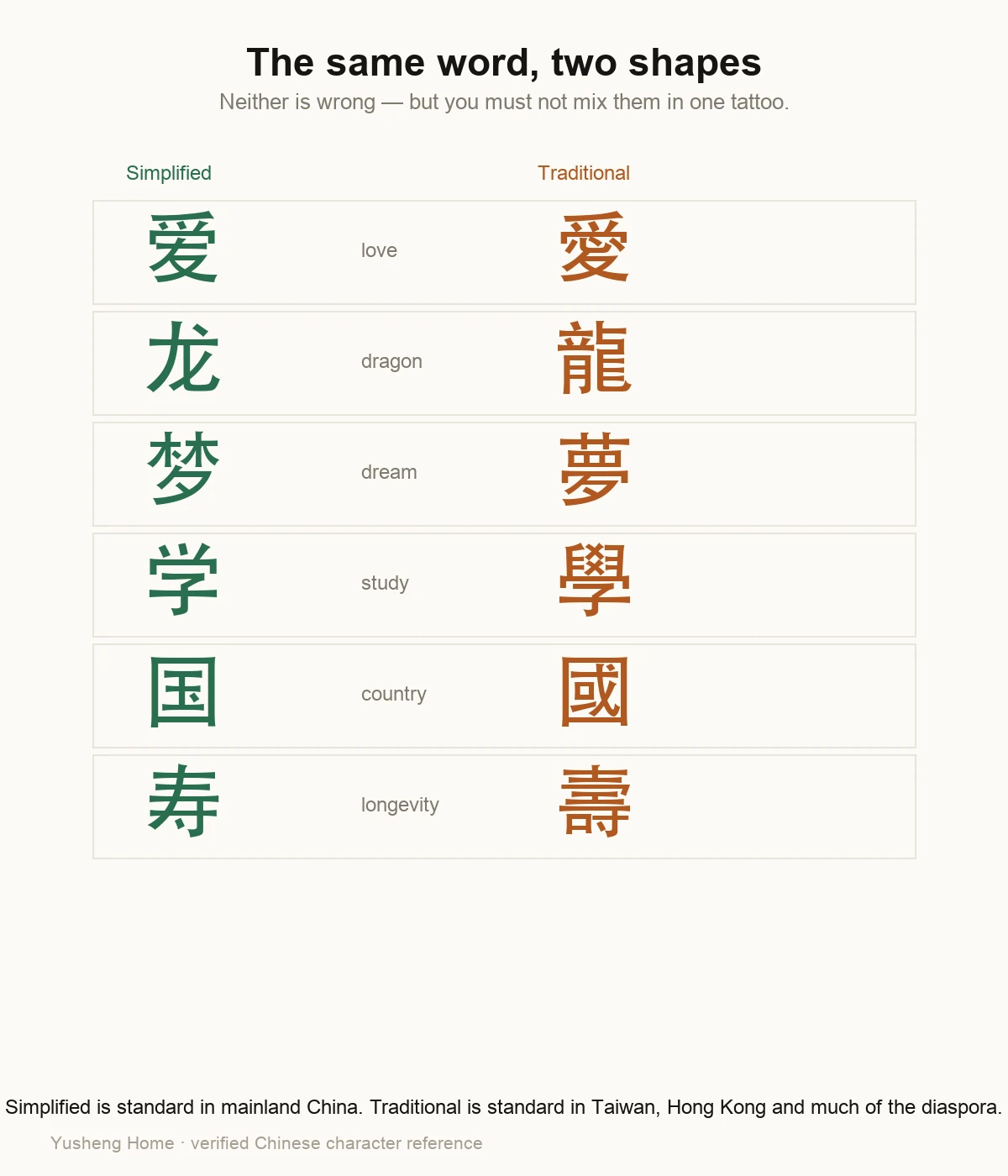
The same word, two shapes
| Meaning | Simplified | Traditional | Note |
|---|---|---|---|
| love | 爱 | 愛 | 13 strokes vs 10 |
| dragon | 龙 | 龍 | much denser traditional form |
| righteousness | 义 | 義 | — |
| study | 学 | 學 | — |
| dream | 梦 | 夢 | — |
| horse | 马 | 馬 | — |
How to choose for a tattoo
- By audience. If the people you most want to read it live in Taiwan, Hong Kong or overseas Chinese communities, traditional is the natural choice. For mainland China, simplified.
- By legibility. At small sizes, simplified characters generally hold up better because they contain fewer strokes and more space between them.
- By character. Traditional forms often carry a more classical, formal feeling; simplified forms can look cleaner and more modern.
- By accuracy, not accident. The important thing is to choose deliberately. The mistake is not picking “the wrong system” — it is mixing the two inside one design.
Common mistakes with the two systems
- Mixing systems in one phrase. A simplified character next to a traditional one reads as an error to any Chinese speaker, like switching alphabets mid-sentence.
- Copying Japanese forms. Japanese uses many of the same characters, but some words mean something completely different in Chinese — 手紙 means “letter” in Japanese and “toilet paper” in Chinese.
- Assuming more strokes means more meaning. The two forms mean the same thing; the difference is shape, not depth.
- Choosing by an image you cannot verify. Some online designs use characters that were simplified incorrectly, or that do not exist in either standard.
What this means for your design
Once you choose a system, the rest of the design follows: the stroke count determines how much space the character needs, which determines the minimum tattoo size, which determines where it can go. Dense traditional characters need more room than a simplified character with the same meaning; shrinking them to fit a small placement is how strokes blur together and the character slowly becomes a different one.
Frequently asked questions
Are simplified and traditional Chinese both real Chinese?
Yes. They are two standard writing systems for the same language. Simplified characters are standard in mainland China and Singapore; traditional characters are standard in Taiwan, Hong Kong, Macau and many overseas communities.
Which one is better for a tattoo?
Neither is better in principle. Simplified characters have fewer strokes and often read more cleanly at small sizes. Traditional characters keep the older forms and often look more classical. Choose by audience or aesthetics, then keep the whole design consistent.
Can I mix simplified and traditional characters?
No. Mixing the two systems inside one word or phrase looks like an error to any Chinese reader, in the same way as mixing two alphabets would in English.
Will Chinese speakers recognize traditional characters?
Most adult readers in mainland China can read common traditional characters, and readers in Taiwan and Hong Kong use them daily. Simplified characters are also widely recognized outside the mainland, though some traditional-only readers are less familiar with them.
My design came from a Japanese source — is that a problem?
It can be. Japanese uses many of the same characters, but some common combinations mean something different in Chinese. Check the phrase as Chinese, not as Japanese, before you commit.
Does the choice change the number of strokes?
Often, a lot. 爱 has 10 strokes and 愛 has 13; 龙 has 5 and 龍 has 16. That changes how a design ages at small sizes: fewer, longer strokes usually hold up better than dense clusters of fine strokes.