Chinese Tattoo Guide · Reviewed against a native Chinese editor's notes
Is a Chinese character tattoo safe?
What “unsafe” actually means for a Chinese tattoo
People search for “is a Chinese tattoo safe” for two different reasons: they are worried about the tattoo itself, or they are worried about the meaning. The first is a standard tattoo question. The second is where almost all the real-world mistakes happen, and it breaks down into four types.
- A wrong character. Chinese characters are built from strokes, and several everyday characters differ by a single stroke or by the length of one stroke. If the artist redraws the character by hand instead of following a stencil, the result can quietly become a different word.
- A wrong meaning. A dictionary translates a character, but it does not tell you whether the word works on its own, whether it is formal or casual, or whether it carries a connotation you do not want. Many characters only make sense inside a phrase.
- A wrong form. Simplified and traditional Chinese use different shapes for the same word — 爱 and 愛 are both “love”. Both are correct, but mixing forms inside one word, or copying a Japanese form while believing it is Chinese, creates something a reader will notice immediately.
- A wrong rendering. Mirrored, rotated or heavily stylised characters stop being readable. Fine-stroke calligraphy shrunk to a few centimetres can blur into an unrelated character within a few years.
One-stroke differences: characters that change meaning
These are the pairs that catch people out most often. They are not obscure — they are common characters, which is exactly why a mistake is visible to any Chinese reader.
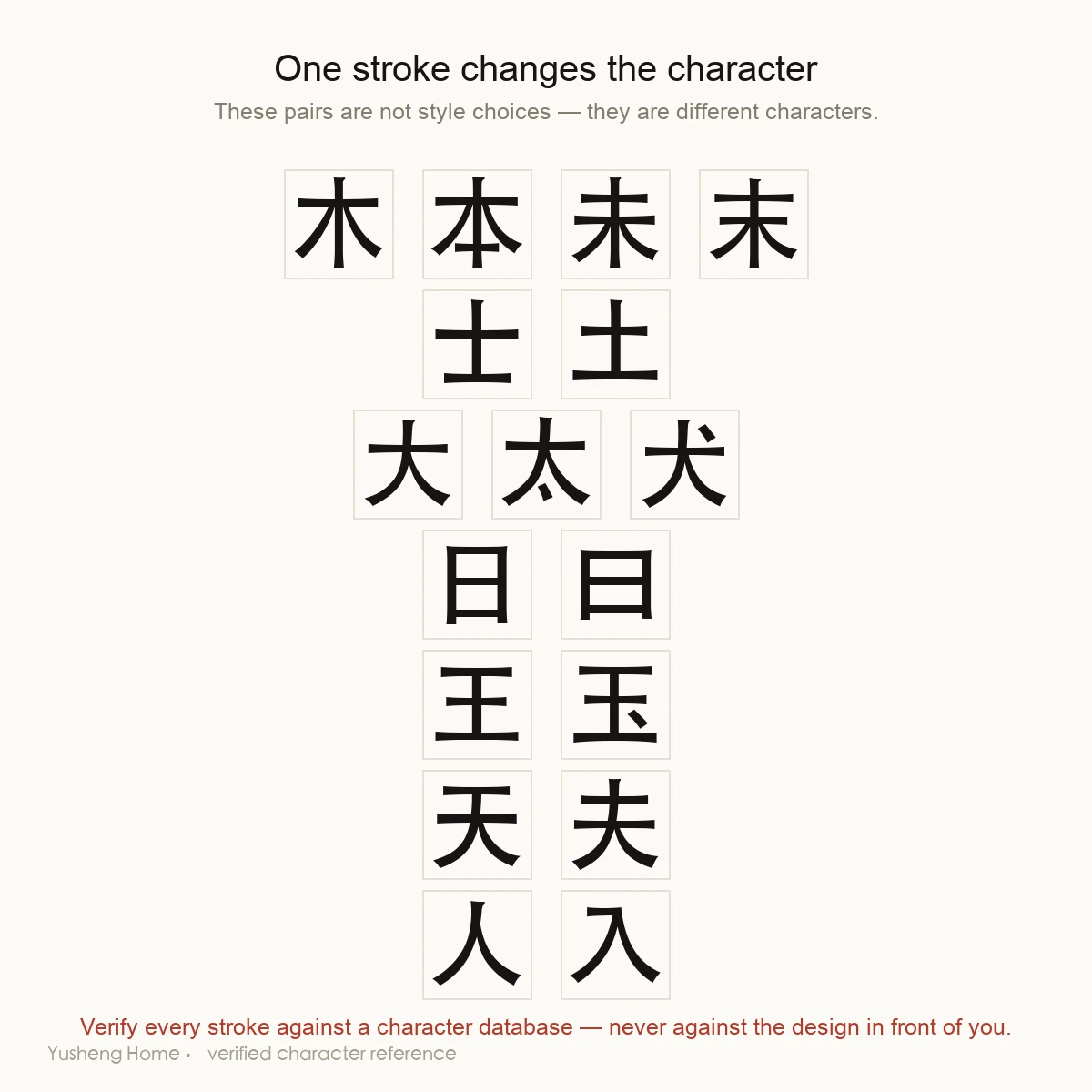
| Character | Pinyin | Meaning | Confused with |
|---|---|---|---|
| 木 | mù | wood, tree | 本 běn (root) · 未 wèi (not yet) · 末 mò (end) |
| 士 | shì | scholar, soldier | 土 tǔ (earth) |
| 大 | dà | big | 太 tài (too, very) · 犬 quǎn (dog) |
| 日 | rì | sun, day | 曰 yuē (to say) |
| 王 | wáng | king | 玉 yù (jade) |
| 天 | tiān | sky, heaven | 夫 fū (man, husband) |
| 人 | rén | person | 入 rù (to enter) |
| 力 | lì | strength | 刀 dāo (knife) |
This is why a stroke-count check matters as much as a translation check. A character with the right translation but the wrong stroke count is still the wrong character.
Simplified or traditional: choose on purpose
Both writing systems are correct Chinese; they are used in different places, and the shape of the same word can look very different. Choosing one deliberately is part of getting the tattoo right.
| Meaning | Simplified | Traditional |
|---|---|---|
| love | 爱 | 愛 |
| dragon | 龙 | 龍 |
| righteousness | 义 | 義 |
| study, learning | 学 | 學 |
| dream | 梦 | 夢 |
Simplified characters are used in mainland China and Singapore. Traditional characters are used in Taiwan, Hong Kong, Macau and by many overseas Chinese communities. Simplified forms usually have fewer strokes, which can read more cleanly at a small size; traditional forms often carry a more classical feel. Neither is “more correct”. What you should avoid is mixing the two inside one word, or copy-pasting a Japanese form while calling it Chinese.
The kanji trap: when the same character means something else in Japanese
Many Chinese-character tattoo designs circulate online through Japanese sources. The characters overlap, but some common combinations mean completely different things in the two languages — and a Chinese reader will read them as Chinese.
- 大丈夫 — in Japanese, “it’s fine / no problem”. Read as Chinese, it means “a real man”.
- 手紙 — in Japanese, “letter”. In Chinese, it means “toilet paper”.
- 娘 — in Japanese, “daughter”. In Chinese, “mother”.
- 勉強 — in Japanese, “study”. In Chinese, “reluctantly”.
None of these are mistakes a dictionary will warn you about. They are mistakes that come from not knowing which language the design was written for.
Cultural context: how tattoos are read in Chinese-speaking places
Getting a Chinese character tattoo is not inherently disrespectful, and it is common around the world. But the cultural backdrop is different from Europe or North America, and it is worth knowing before you choose.
- Historical stigma. Tattooing was historically used as a punishment in China — 墨刑 (mò xíng), an ink punishment applied to the face or body. That history is one reason older generations may still associate visible tattoos with criminality. The neutral modern word for a tattoo is 刺青 (cì qīng).
- Attitudes differ by region and generation. Young people in large cities are generally relaxed about tattoos; some workplaces, schools and official settings in mainland China, Japan and Korea still take a conservative view of visible tattoos.
- Practical constraints. In Japan, some hot springs, pools and gyms restrict visitors with visible tattoos. If you travel, a placement that can be covered gives you more options.
- Respectful choices. Avoid sacred names and religious figures used as decoration, characters for death or funerals, names of real people you have no connection to, and political slogans. A single character with a clear, positive meaning is the safest and most readable choice.
The 6-step verification checklist before you ink
- Start from the meaning, not the picture. Decide what you want the tattoo to say in English first. Then find the character for that meaning — not a character you saw and then reverse-translated.
- Confirm the form. Decide simplified or traditional, and check that every character in the design uses the same system.
- Check the stroke count. Compare your character against a verified reference. A stroke-count difference means a different character, even if it looks almost identical.
- Read it in context. Ask whether the word stands alone or only works inside a phrase. If you want more than one character, use a fixed, well-known expression rather than assembling characters yourself.
- Test it at real size and in the final font. Print or preview the character at the size it will be tattooed. Regular script stays readable; very fine or highly cursive styles can blur.
- Get a native reader to confirm the final stencil. This is the step that catches mirrored, rotated or hand-redrawn characters. It takes minutes and eliminates the whole category of “wrong character” regret.
Characters that age well
Single characters with strong, widely understood meanings are the safest category, because they are hard to misread and most readers can confirm them instantly. Common examples:
- 勇 (yǒng) — courage, bravery
- 爱 / 愛 (ài) — love, deep affection
- 福 (fú) — blessing, good fortune
- 家 (jiā) — family, home
- 和 (hé) — harmony, peace
- 忍 (rěn) — patience, endurance
- 信 (xìn) — trust, faith
- 恩 (ēn) — gratitude, kindness
- 龙 / 龍 (lóng) — dragon
If you want a longer phrase, choose a fixed four-character idiom (成语, chéngyǔ) such as 否极泰来 (pǐ jí tài lái — “after adversity comes good fortune”). Fixed expressions are safe because their wording and meaning are established; a phrase you build yourself character by character usually is not.
Font, direction and placement
- Regular script (楷书) is the most legible and the easiest for a tattoo artist to reproduce faithfully. It is the default recommendation for a first Chinese tattoo.
- Seal script (篆书) looks classical, but many readers cannot verify it, and the same shape can be ambiguous. Use it only if a native reader has confirmed the exact rendering.
- Cursive script (草书) is beautiful but highly stylised. At tattoo scale it can lose the strokes that identify the character.
- Do not mirror or rotate characters. A mirrored Chinese character is not a stylistic variation — it is incorrect, and sometimes a different character or meaningless.
- Vertical layout is traditional and works well for single or paired characters; horizontal layout is also fine. What matters is that each character keeps its correct proportions.
- Placement: areas that don’t stretch heavily (forearm, upper back, calf) hold fine strokes better over time than areas that stretch most (ribs, lower abdomen).
Frequently asked questions
Is a Chinese character tattoo safe?
Yes. The tattoo itself carries the same risks as any tattoo (hygiene, healing, artist skill). The specific risk with a Chinese character tattoo is that the character or its meaning is wrong. If the character is confirmed by a native reader before the tattoo is drawn, it is safe.
Can one stroke really change the meaning?
Yes. Chinese characters are built from strokes, and several common characters differ by a single stroke or by the length of one stroke: 木 (mù, wood) and 本 (běn, root), 士 (shì, scholar) and 土 (tǔ, earth), 大 (dà, big) and 犬 (quǎn, dog). A missing or added stroke does not look slightly off — it is a different character with a different meaning.
Should I choose simplified or traditional characters?
Both are correct Chinese. Simplified characters (mainland China, Singapore) have fewer strokes and read more cleanly at small sizes. Traditional characters (Taiwan, Hong Kong, Macau, many overseas communities) keep the older forms, such as 愛 instead of 爱. Choose deliberately and do not mix forms inside one word.
Is it offensive to get a Chinese tattoo if I am not Chinese?
It is generally not considered offensive on its own, and it is common worldwide. What draws criticism is carelessness: characters copied from unverified sources, invented phrases no Chinese speaker would say, sacred or religious names used as decoration, or symbols with criminal or political meanings the wearer does not understand.
What if my tattoo artist cannot read Chinese?
That is common and workable. Bring a stencil with the exact character, the pinyin, the meaning and the stroke order, and ask the artist to follow the stencil rather than redraw it. Ask them not to mirror, rotate or “balance” the character, because those changes create a different character or make it unreadable.
Are there Chinese characters I should avoid?
Avoid anything you cannot fully explain: characters linked to crime or punishment, surnames or personal names you have no connection to, characters for death or funerals, and political slogans. Also avoid very rare characters that most readers cannot recognise, because nobody around you can verify them.
Do I need a native speaker, or can I use a dictionary?
A dictionary gives the meaning of a character, but not whether it works as a standalone word, which form is used where, or how it reads as a tattoo. A native reader catches those problems in seconds. Use a dictionary to search, and a native reader to confirm.
How long does it take to verify a character?
A careful check takes minutes, not days: confirm the character, the simplified or traditional form, the stroke count, and how it reads at the size and font you want. The expensive mistake is skipping that step, not doing it.