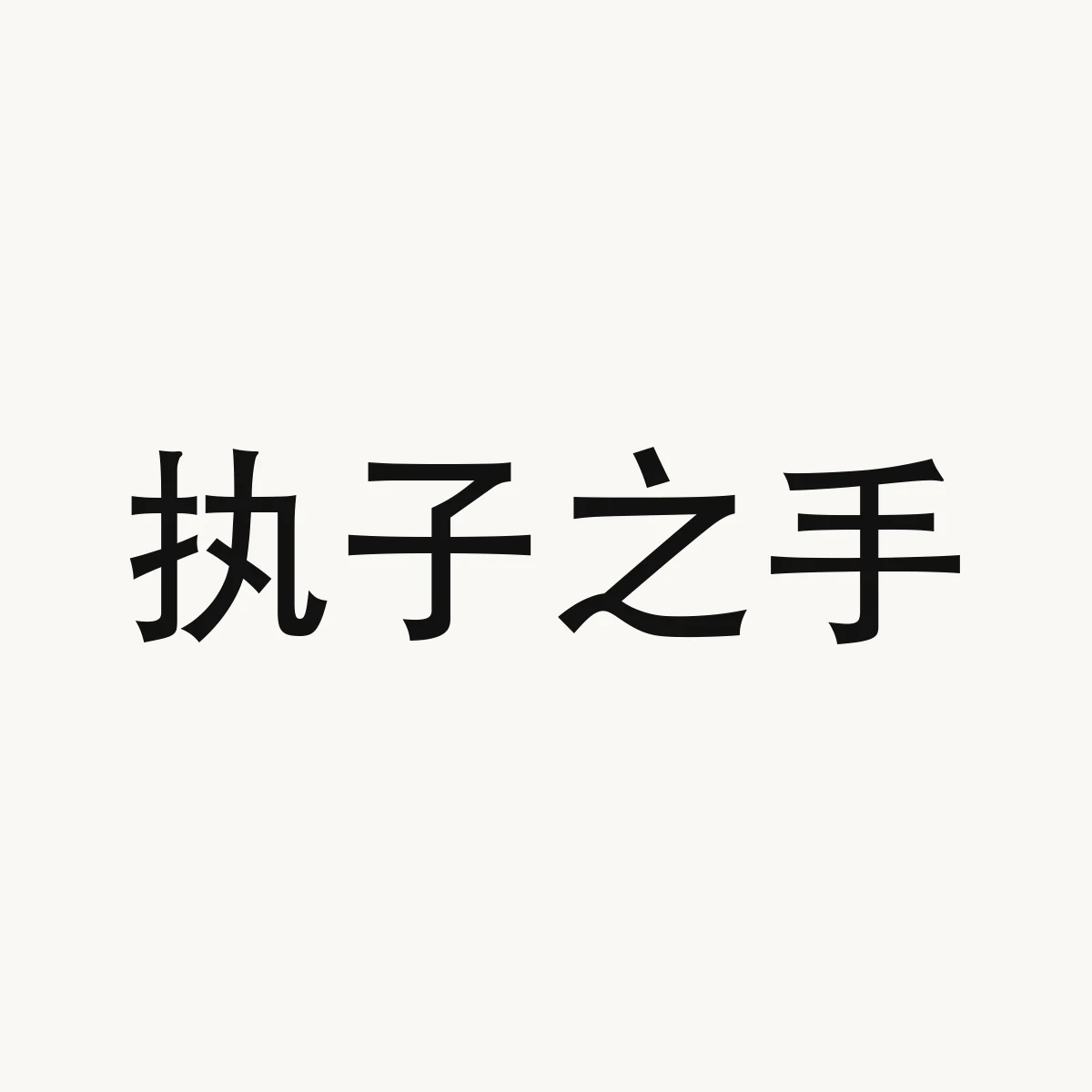
Chinese Blessing 执子之手: Meaning & Design Guide
执子之手 is a fixed Chinese expression. Below: each character broken down, and how the phrase works as a wallpaper.
Character by character
| Character | Pinyin | Meaning | Strokes |
|---|---|---|---|
| 执 | zhí | hold in hand; keep; carry out | 6 |
| 子 | zǐ | offspring, child; fruit, seed of; first earthly branch | 3 |
| 之 | zhī | marks preceding phrase as modifier of following phrase; it, him her, them; go to | 3 |
| 手 | shǒu | hand | 4 |
Per-character data: Unihan (Unicode).
Words using these characters
| Word | Pinyin | Meaning | HSK |
|---|---|---|---|
| 执行 | zhí xíng | to implement | newest-5 |
| 执法 | zhí fǎ | to enforce a law | newest-7 |
| 争执 | zhēng zhí | to dispute | newest-7 |
| 孩子 | hái zi | child | newest-1 |
| 儿子 | ér zi | son | newest-1 |
| 房子 | fáng zi | house | newest-3 |
Words: HSK vocabulary list · meanings: CC-CEDICT.
Size and layout for 执子之手
执子之手 is evenly weighted (3–6 strokes across 4 characters), so it holds together well in a straight line or a square block without optical adjustment. With 16 strokes in total it needs more room than a single character: give it a square or A3 ratio rather than a narrow phone crop. A four-character expression is usually set as a 2×2 block or one horizontal line — pick one and keep it consistent.
Using 执子之手
执子之手 is a set phrase. Because it is fixed, changing a character changes the meaning entirely — check the wording with a native reader before it goes on skin or paper. Regular script (楷书) keeps every stroke countable, which matters when someone checks the character. Avoid mirroring or rotating the character, and avoid very fine or cursive styles at small sizes, where strokes merge into shapes that read as a different character.
Frequently asked questions
What does 执子之手 mean?
执子之手 is a fixed Chinese expression; its meaning comes from the phrase as a whole rather than from the individual characters.
How is 执子之手 pronounced?
Check the pronunciation with a native speaker before inking, since each character is pronounced separately.
Is 执子之手 a fixed expression?
Yes — it is a set phrase, which is safer than assembling characters yourself. Fixed expressions keep their established wording and meaning.
How should 执子之手 be laid out?
A four-character expression is usually written as a 2×2 square block or a single horizontal line. Keep the characters the same size and do not mirror or rotate any of them.
Which style suits 执子之手?
Bold regular script keeps every stroke clear. With multiple characters, avoid very fine or highly cursive styles — the smaller each character gets, the more the strokes merge.
Do I need to verify the phrase?
Yes. Confirm the wording, the meaning and the full context with a native reader, and check that the phrase is not a quotation about misfortune or parting.
How many strokes in total?
执子之手 is written with 16 strokes across 4 characters — which is why it needs more space than a single character.
Want 执子之手 as a ready-to-use wallpaper or print?
✦ Get this artworkNot ready? Browse blessings · Full index
Character data: Unihan (Unicode) · words: HSK vocabulary & CC-CEDICT · How we verify this