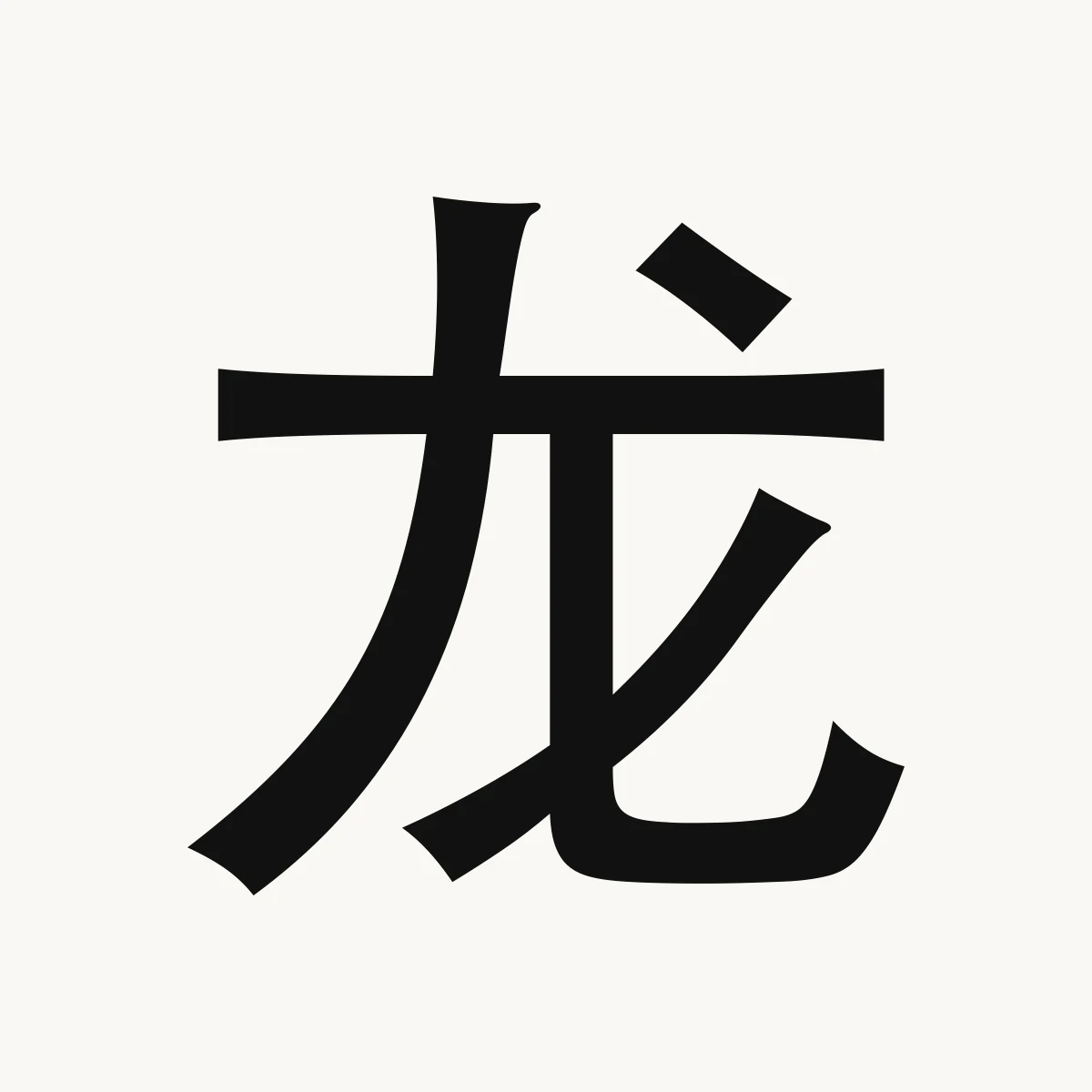
Chinese Blessing 龙: Meaning, Strokes & Design Guide
The character 龙 means "dragon; symbolic of emperor" and is pronounced lóng. Below: its structure, the words it appears in, and how it works as a wallpaper.
Quick facts
| Character | 龙 |
| Pinyin | lóng |
| Meaning | dragon; symbolic of emperor |
| Strokes | 5 |
| Radical | ⿓ (No. 212) |
| HSK level | newest-5 |
Words that contain 龙
| Word | Pinyin | Meaning | HSK |
|---|---|---|---|
| 沙龙 | shā lóng | salon (loanword) | newest-7 |
| 恐龙 | kǒng lóng | dinosaur | newest-7 |
| 水龙头 | shuǐ lóng tóu | faucet | newest-7 |
| 尼龙 | ní lóng | nylon (loanword) | new-7 |
| 龙舟 | lóng zhōu | dragon boat | new-7 |
| 跑龙套 | pǎo lóng tào | to play a small role | newest-7 |
Words and levels: HSK vocabulary list · meanings: CC-CEDICT.
Size and layout for 龙
龙 is a simple character — only 5 strokes — which means it stays readable even at thumbnail size, but can look sparse and lost on a large canvas. Scale it up and let the surrounding space do the work rather than adding decoration.
Using 龙
龙 is used on its own and inside compounds, so context decides which sense is read. Here it carries “dragon; symbolic of emperor”. Regular script (楷书) keeps every stroke countable, which matters when someone checks the character. Avoid mirroring or rotating the character, and avoid very fine or cursive styles at small sizes, where strokes merge into shapes that read as a different character.
Frequently asked questions
What does 龙 mean?
龙 (lóng) means “dragon; symbolic of emperor”.
How is 龙 pronounced?
龙 is pronounced lóng in Mandarin.
How many strokes does 龙 have?
龙 has 5 strokes, under the ⿓ radical (No. 212).
What size should a 龙 wallpaper be?
With 5 strokes, 龙 is open and stays clear even at phone-wallpaper size.
Which style works for 龙?
For a wallpaper, regular script (楷书) stays legible at every size; seal script (篆书) looks classical and works best large; a clean modern layout suits phone and desktop formats.
Is 龙 common in modern Chinese?
Yes — 龙 appears as a standalone HSK vocabulary item (newest-5), and in everyday words such as 沙龙、恐龙、水龙头.
Should I use simplified or traditional 龙?
龙 is written the same in simplified and traditional Chinese, so there is no form to choose.
Want 龙 as a ready-to-use wallpaper or print?
✦ Get this artworkNot ready? Browse blessings · Full index
Character data: Unihan (Unicode) · words: HSK vocabulary & CC-CEDICT · How we verify this