Chinese Blessing 虎: Meaning, Strokes & Design Guide
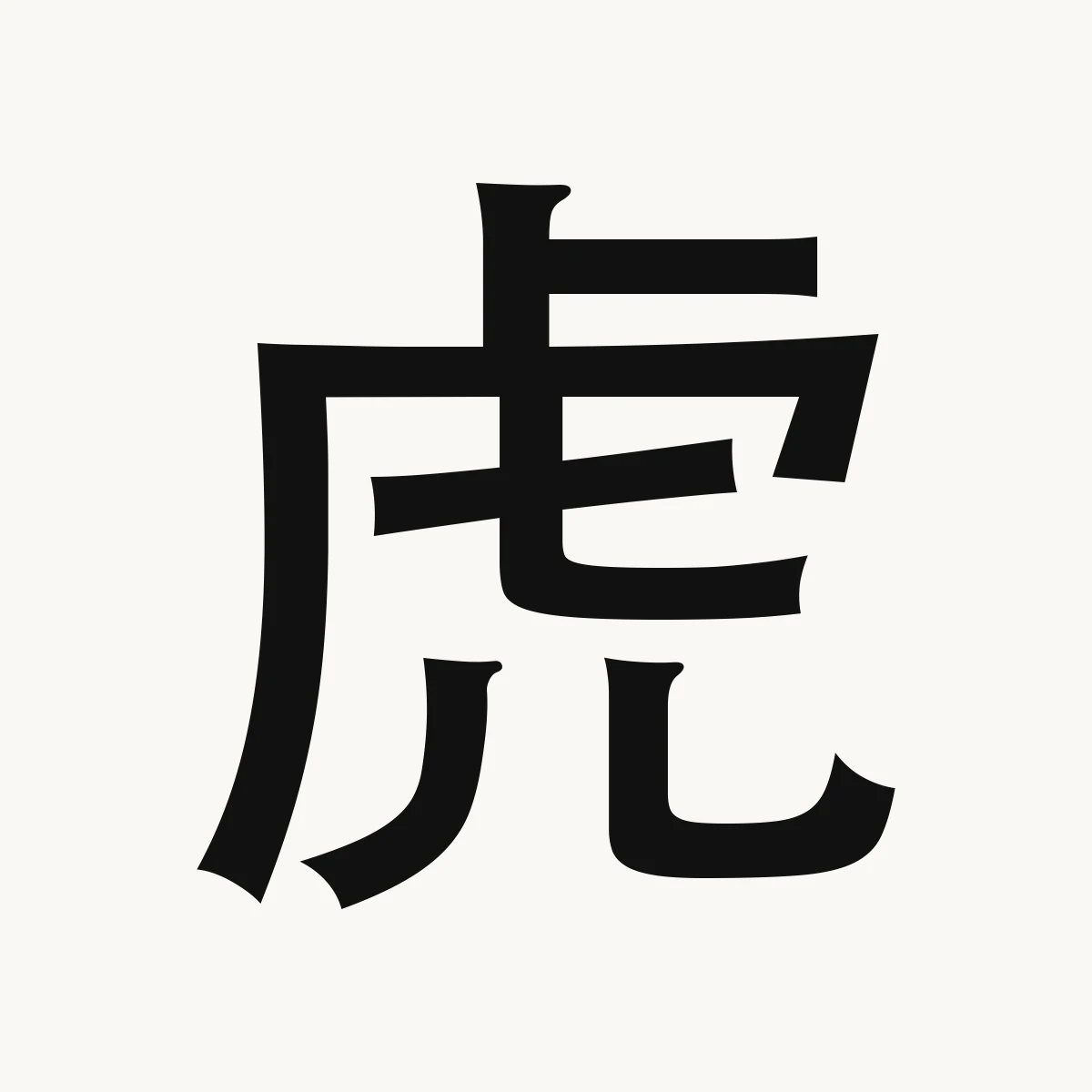
The character 虎 means "tiger; brave, fierce; surname" and is pronounced hǔ. Below: its structure, the words it appears in, and how it works as a wallpaper.
Quick facts
| Character | 虎 |
| Pinyin | hǔ |
| Meaning | tiger; brave, fierce; surname |
| Strokes | 8 |
| Radical | ⾌ (No. 141) |
| HSK level | new-5 |
Words that contain 虎
| Word | Pinyin | Meaning | HSK |
|---|---|---|---|
| 老虎 | lǎo hǔ | tiger | newest-4 |
| 马虎 | mǎ hu | careless | newest-6 |
| 伏虎 | fu2 hu3 | to subdue a tiger | — |
| 壁虎 | bi4 hu3 | gecko; house lizard | — |
| 寅虎 | yin2 hu3 | Year 3, year of the Tiger (e.g. 2010) | — |
| 猛虎 | meng3 hu3 | fierce tiger | — |
Words and levels: HSK vocabulary list · meanings: CC-CEDICT.
Size and layout for 虎
虎 sits in the middle range at 8 strokes: legible on a phone screen, and balanced enough to print at A4. Choose the size by where it will be seen first — phone wallpaper or framed print — and let the other format follow.
Using 虎
虎 is used on its own and inside compounds, so context decides which sense is read. Here it carries “tiger; brave, fierce; surname”. Regular script (楷书) keeps every stroke countable, which matters when someone checks the character. Avoid mirroring or rotating the character, and avoid very fine or cursive styles at small sizes, where strokes merge into shapes that read as a different character.
Frequently asked questions
What does 虎 mean?
虎 (hǔ) means “tiger; brave, fierce; surname”.
How is 虎 pronounced?
虎 is pronounced hǔ in Mandarin.
How many strokes does 虎 have?
虎 has 8 strokes, under the ⾌ radical (No. 141).
What size should a 虎 wallpaper be?
With 8 strokes, 虎 is open and stays clear even at phone-wallpaper size.
Which style works for 虎?
For a wallpaper, regular script (楷书) stays legible at every size; seal script (篆书) looks classical and works best large; a clean modern layout suits phone and desktop formats.
Is 虎 common in modern Chinese?
Yes — 虎 appears as a standalone HSK vocabulary item (new-5), and in everyday words such as 老虎、马虎、伏虎.
Should I use simplified or traditional 虎?
虎 is written the same in simplified and traditional Chinese, so there is no form to choose.
Want 虎 as a ready-to-use wallpaper or print?
✦ Get this artworkNot ready? Browse blessings · Full index
Character data: Unihan (Unicode) · words: HSK vocabulary & CC-CEDICT · How we verify this