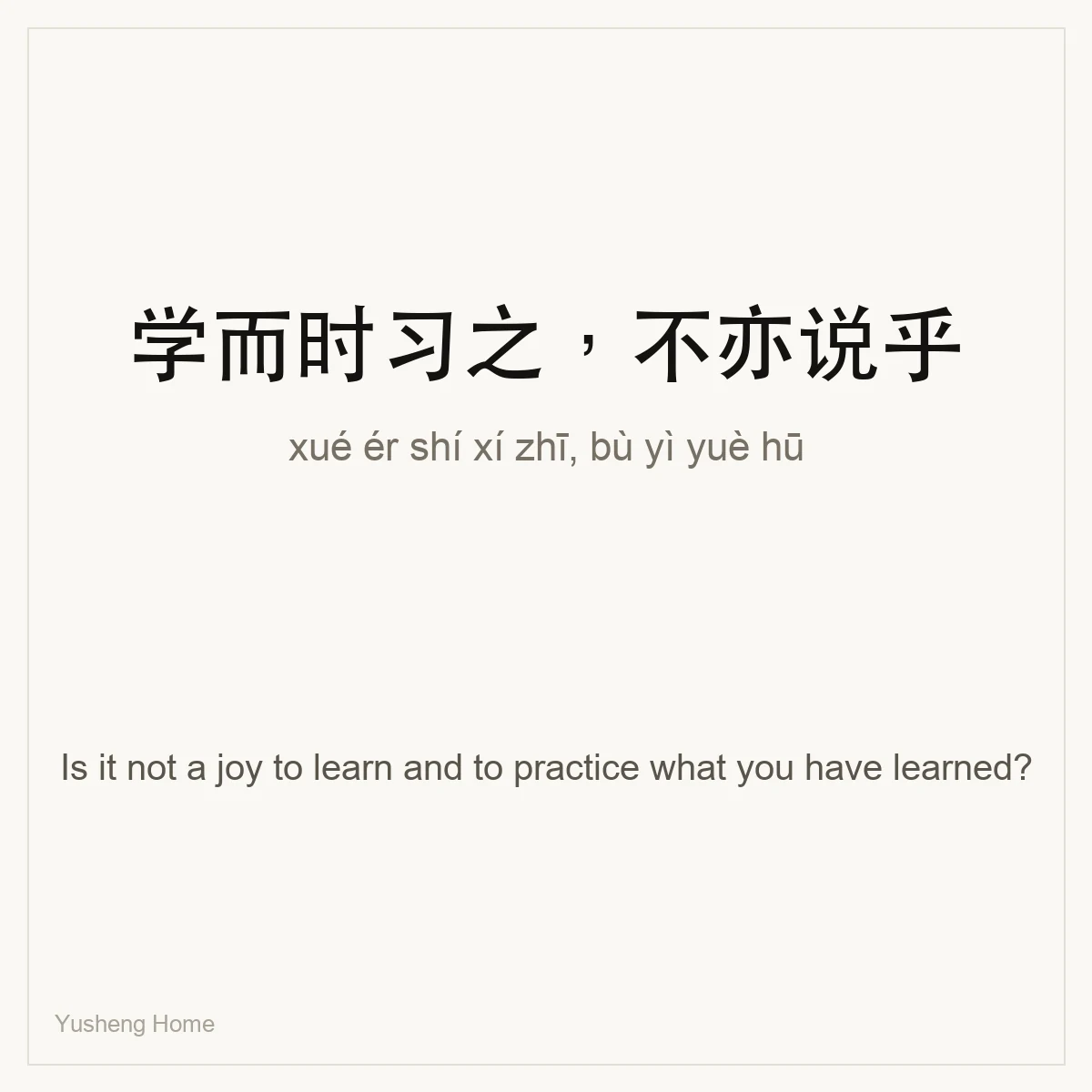
学而时习之,不亦说乎 — "Is it not a joy to learn and to practice what you have learned?" | Chinese Proverb Explained
From Analects · 论语: "Is it not a joy to learn and to practice what you have learned?"
What it means
"Is it not a joy to learn and to practice what you have learned?" This timeless Chinese saying has guided readers for over two millennia.
Where it comes from
Analects · 论语. The original text is classical Chinese; this is a faithful modern English rendering.
More wisdom to explore
Get the complete classics collection — Tao Te Ching, Art of War, Analects and I Ching — as a beautiful PDF.
✦ Get the Classics PDFChinese Classics · yusheng-home.com
Character by character
| Character | Pinyin | Meaning | Strokes |
|---|---|---|---|
| 学 | xué | learning, knowledge; school | 8 |
| 而 | ér | and; and then; and yet; but; Kangxi radical 126 | 6 |
| 时 | shí | time, season; era, age, period | 7 |
| 习 | xí | practice; flapping wings | 3 |
| 之 | zhī | marks preceding phrase as modifier of following phrase; it, him her, them; go to | 3 |
| 不 | bù | no, not; un-; negative prefix | 4 |
| 亦 | yì | also, too; likewise | 6 |
| 说 | shuō | speak, say, talk; scold, upbraid | 9 |
| 乎 | hū | interrogative or exclamatory final particle | 5 |
Character data: Unihan (Unicode).
Reading it in context
This line comes from Analects · 论语. Classical Chinese is compact: each character carries meaning, and the sense of the sentence depends on how they are read together. The usual translation is: “Is it not a joy to learn and to practice what you have learned?”. Because the grammar is compressed, translations differ — which is also why a literal character-by-character reading can go wrong.
Using this saying
At 9 characters, this is a full sentence rather than a slogan — from Analects · 论语. It suits a larger canvas (a framed piece, a back or rib placement) where the whole line can be read in one glance. Compressing it into a small area tends to break it into fragments that lose the sense. Keep the whole line together: a fragment can change the meaning, and the source is part of the value. If you adapt it for a design or inscription, have the exact wording checked by a native reader.
Frequently asked questions
What does it mean?
Is it not a joy to learn and to practice what you have learned?
Where does it come from?
It is recorded in Analects · 论语.
Can I use just part of the line?
It is safer to use the whole phrase. Classical lines are often quoted in full because the meaning depends on the whole construction.
Is the translation exact?
No short translation is exact. Classical Chinese compresses grammar, so translations vary — check with a native reader if the wording matters.