Chinese Tattoo 刚: Meaning, Strokes & Design Guide
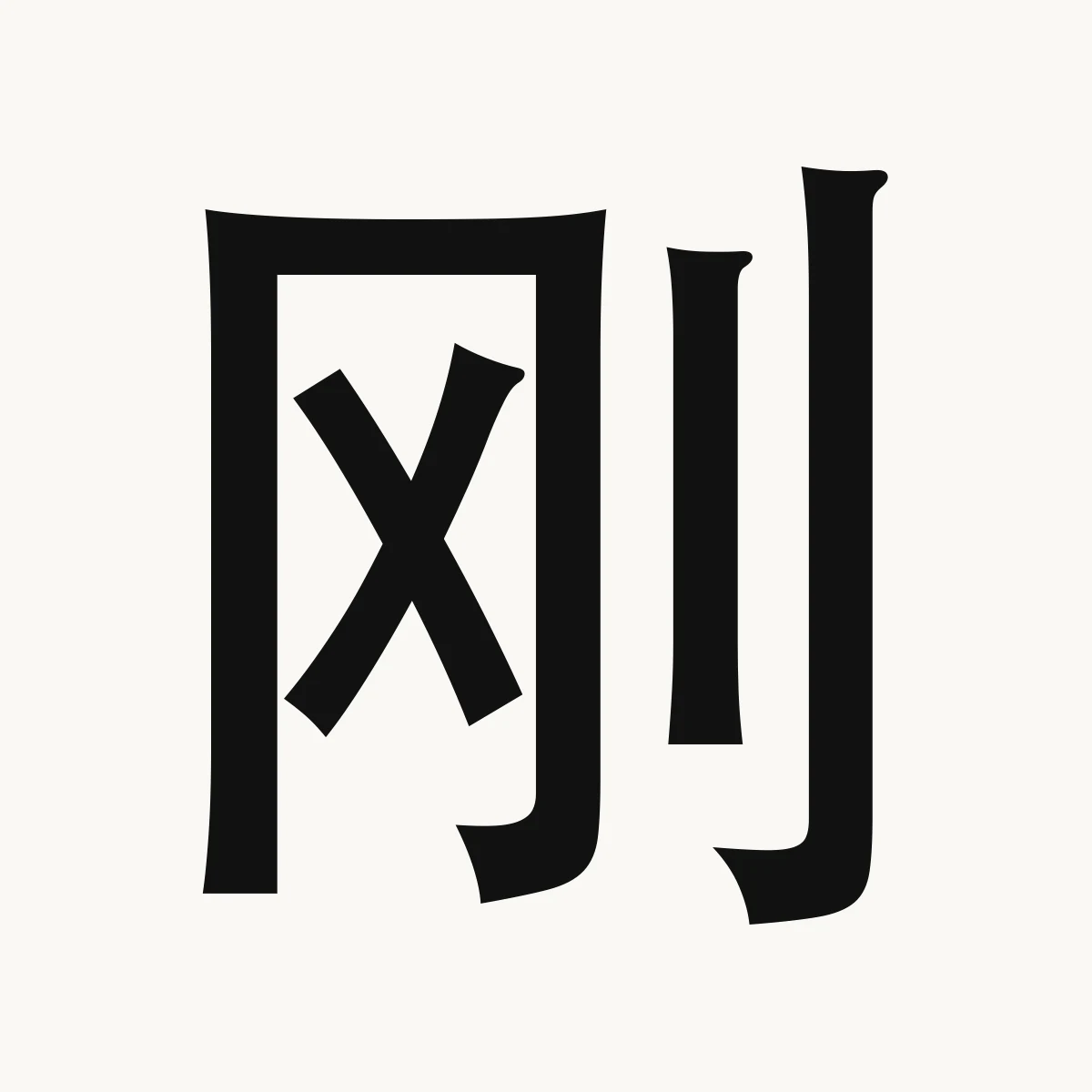
The character 刚 means "hard, tough, rigid, strong" and is pronounced gāng. Below: its structure, the words it appears in, and how it works as a tattoo.
Quick facts
| Character | 刚 |
| Pinyin | gāng |
| Meaning | hard, tough, rigid, strong |
| Strokes | 6 |
| Radical | ⼑ (No. 18) |
| HSK level | newest-3 |
Words that contain 刚
| Word | Pinyin | Meaning | HSK |
|---|---|---|---|
| 刚刚 | gāng gang | just recently | newest-3 |
| 刚才 | gāng cái | just now | newest-3 |
| 刚好 | gāng hǎo | just | newest-5 |
| 刚毅 | gāng yì | resolute | new-7 |
| 刚一 | gang1 yi1 | to be just about to | — |
| 刚健 | gang1 jian4 | energetic | — |
Words and levels: HSK vocabulary list · meanings: CC-CEDICT.
Placing 刚
刚 has 6 strokes — enough detail to survive a smaller placement, but not so much that it closes up. It is a practical size for a forearm, calf or upper arm. Agree the final stencil size with your artist before the appointment. Bring the stencil together with the pinyin and the meaning, and ask the artist to follow the stencil rather than redrawing the character freehand — freehand redrawing is the most common way a correct character loses a stroke and becomes a different one.
Design notes for 刚
刚 appears both on its own and inside compounds, so the sense depends on context; here it reads “hard, tough, rigid, strong”. Regular script (楷书) keeps every stroke countable, which matters when a Chinese reader checks it. Avoid mirroring or rotating the character, and avoid very fine or cursive styles at small sizes, where strokes merge into a shape that reads as a different character.
Frequently asked questions
What does 刚 mean?
刚 (gāng) means “hard, tough, rigid, strong”.
How is 刚 pronounced?
刚 is pronounced gāng in Mandarin.
How many strokes does 刚 have?
刚 has 6 strokes, under the ⼑ radical (No. 18).
How large should a 刚 tattoo be?
With 6 strokes, 刚 is open and holds detail well even at small sizes.
Which style works for 刚?
Bold regular script (楷书) keeps the strokes clear. Semi-cursive (行书) adds flow but softens edges. Seal script looks classical but is harder for most readers to verify — use it only if a native reader has confirmed the rendering.
Is 刚 common in modern Chinese?
Yes — 刚 appears as a standalone HSK vocabulary item (newest-3), and in everyday words such as 刚刚、刚才、刚好.
Should I use simplified or traditional 刚?
刚 is written the same in simplified and traditional Chinese, so there is no form to choose.
Want 刚 as a ready-to-use stencil with a native-checked meaning card, sized for your tattoo artist?
✦ Get this designNot ready? Browse more characters · All 150+ characters
Character data: Unihan (Unicode) · words: HSK vocabulary & CC-CEDICT · How we verify this