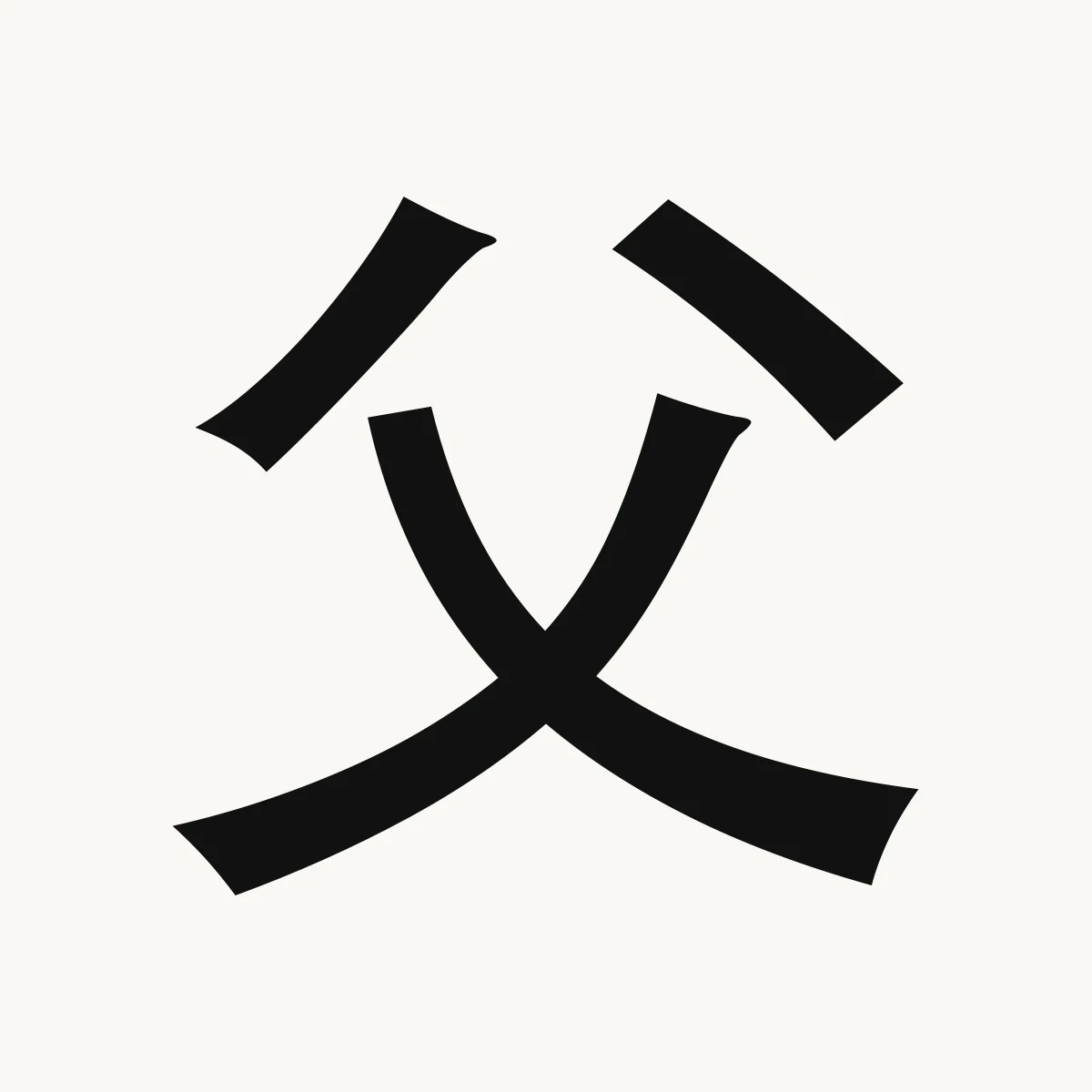
Chinese Tattoo 父: Meaning, Strokes & Design Guide
The character 父 means "father; Kangxi radical 88" and is pronounced fù. Below: its structure, the words it appears in, and how it works as a tattoo.
Quick facts
| Character | 父 |
| Pinyin | fù |
| Meaning | father; Kangxi radical 88 |
| Strokes | 4 |
| Radical | ⽗ (No. 88) |
Words that contain 父
| Word | Pinyin | Meaning | HSK |
|---|---|---|---|
| 父亲 | fù qīn | father | newest-4 |
| 父母 | fù mǔ | father and mother; parents | newest-4 |
| 师父 | shī fu | used for 师傅 (in Taiwan) | newest-6 |
| 父子 | fù zǐ | father and son | newest-4 |
| 祖父 | zǔ fù | father's father | newest-7 |
| 父女 | fù nǚ | father and daughter | newest-4 |
Words and levels: HSK vocabulary list · meanings: CC-CEDICT.
Placing 父
父 is only 4 strokes, so it stays readable even small — but a simple character shows every wobble. There is nowhere to hide a shaky line here, so line weight and steady spacing matter more than with a dense character. Bring the stencil together with the pinyin and the meaning, and ask the artist to follow the stencil rather than redrawing the character freehand — freehand redrawing is the most common way a correct character loses a stroke and becomes a different one.
Design notes for 父
父 appears both on its own and inside compounds, so the sense depends on context; here it reads “father; Kangxi radical 88”. Regular script (楷书) keeps every stroke countable, which matters when a Chinese reader checks it. Avoid mirroring or rotating the character, and avoid very fine or cursive styles at small sizes, where strokes merge into a shape that reads as a different character.
Frequently asked questions
What does 父 mean?
父 (fù) means “father; Kangxi radical 88”.
How is 父 pronounced?
父 is pronounced fù in Mandarin.
How many strokes does 父 have?
父 has 4 strokes, under the ⽗ radical (No. 88).
How large should a 父 tattoo be?
With 4 strokes, 父 is open and holds detail well even at small sizes.
Which style works for 父?
Bold regular script (楷书) keeps the strokes clear. Semi-cursive (行书) adds flow but softens edges. Seal script looks classical but is harder for most readers to verify — use it only if a native reader has confirmed the rendering.
Is 父 common in modern Chinese?
It appears in everyday words such as 父亲、父母、师父, though it is more often used inside compounds than alone.
Should I use simplified or traditional 父?
父 is written the same in simplified and traditional Chinese, so there is no form to choose.
Want 父 as a ready-to-use stencil with a native-checked meaning card, sized for your tattoo artist?
✦ Get this designNot ready? Browse more characters · All 150+ characters
Character data: Unihan (Unicode) · words: HSK vocabulary & CC-CEDICT · How we verify this